The Web address of this
article is
https://sfhelp.org/cx/tools/bubble.htm
Updated
01-11-2015
Clicking underlined links here will open a
new window. Other links will open an informational popup,
so please turn off your
browser's popup blocker or allow popups from this nonprofit Web site.
If your playback device doesn't support Javascript, the popups may not display.
Follow underlined links after
finishing this article to avoid getting lost.
This is one of the articles
inLesson 2 - learn communication basics and seven powerful
skills
to get more needs met more often.
Progress with this Lesson
depends on simultaneous progress on Lesson 1 - free your
wise
true Self to guide your
personality in calm and conflictual times.
This brief YouTube video summarizes what you'll read here.
The video mentions eight self-improvement lessons in this Web site -
I've simplified that to seven:
This article describes a powerful dynamic that affects communication
outcomes between any two people.
Awareness of this dynamic will help you to avoid and resolve some communication
problems.
The article assumes
you're familiar with...
the intro
to this nonprofit Web site and the premises
underlying it
Premises: Any perceived attitude or behavior in person "A" that causes a "significant"
mental, emotional, physical, or spiritual effect in person "B" is
"communication." Intentional communication aims to fill
one or more current needs. When people
communicate, each partner unconsciously maintains a flexible "bubble" of
awareness. Of four types ofbubble,
only one promotes
effective communication by implying genuine mutual respect. See which of these four situations best describes typical communication sequences between you
and key adults and kids.
1) Each
person focuses only on their own
needs. Their awareness bubble includes only themselves at the
moment i.e. my thoughts, feelings, body, and needs, or all of these.
Either partner may decode this "one-person bubble"
as
disrespectful
(being ignored
by the other).
Frequent 1-person bubbles suggest a
false self
is in control.
Or...
2)
One partner
has a 1-person bubble
and the other partner is equally aware of the thoughts, feelings, and
needs of each of them - i.e. s/he has a "two-person
bubble." When either partner feels ignored (excluded
from their partner's bubble), s/he may feel frustrated and
disrespected, and stop listening - tho s/he may pretend
otherwise.
Or...
3) Neither
partner is aware of their or their partner's current
thoughts, feelings, or
their
communication and
other needs.
They each focus "somewhere
else," like the past, the future, or another person, place,
idea, or event. As long as neither person needs to feel
acknowledged (respected) by the other and/or to make
"personal contact," these "no-person bubbles"
may feel mutually OK.
Wounded,
unaware
adults and kids often overfocus
on their own needs or
other people's needs
- i.e. they habitually maintain ineffective 1-person bubbles. Reducing
inner wounds (
Lesson 1 here) automatically promotes a more balanced [me
+ you +
us]
interpersonal focus.
In important personal and business communications,
the best option
occurs when...
4)
Each partner (a) has a
stable two-person bubble, (b) a genuine
mutual-respect attitude,
and (c) wants to fill each person's current
communication
and
other
needs equally.
Then mutual awareness of effective communication
skills promotes
filling each person's current needs well enough
iftheir
respective
true Selves are guiding their personalities.
Symptoms
To assess awareness bubbles in your communications, look for traits like these:
An adult or child with a 1-person
bubble will...
frequently use the words "I, me, my, myself,
or mine;"
monolog - focus mainly on their own experiences,
feelings, opinions, and needs;
talk or text nonstop, and/or repeatedly
interrupt their partner to re-focus on themselves;
may give little or no eye contact to their
partner;
rarely ask their partner questions - or will
ask, out of duty or politeness rather than real interest;
tend to use many of these communication
blocks;
and...
show subtle or obvious impatience or disinterest
when their partner talks.
Typical
Grown Wounded Children
will deny, discount, apologize for, or justify these 1-bubble traits
rather than seek to correct them.
If
their communication partner is self-aware, s/he will feel increasingly unheard, talked at,
disrespected, bored, and frustrated. This will continue until s/he decides to
confront the speaker or end their exchange.
People who maintain a 2-person bubble
will...
spontaneously use the words "I, me, my, mine,
myself, you, your, yourself, us, we, and our" equally during a typical
conversation;
consistently encourage dialogs (two-way
exchanges) vs. monologs;
seldom interrupt their partner unless s/he
monologs, rambles, or repeats too much;
use or ask for
hearing checks to confirm their
understanding; and s/he will...
maintain comfortable eye contact during a
face-to-face encounter;
feel and exhibit genuine interest in, and
respect and empathy for, their partner; and...
periodically ask their partner sincere,
questions about their thoughts, feelings, and needs, and will usually really
listen and respond empathically to their answers;
When their true
Self guides them, people experiencing a genuine (vs. dutiful), stable 2-person
bubble will enjoy and initiate conversations, feel well-heard and
well-respected, and will feel comfortable with some self-disclosure and intimacy
as the relationship grows.
Noticing and discussing awareness bubbles is part of the powerful communication skills of
awareness and
metatalk.
Requesting a partner to shift to a stable two-person bubble requires (a) your
true Self to guide you, and (b) fluency in assertion + listening +
problem-solving skills (Lesson 2).
Think of the key kids and adults in your life one at a time. Which of these four
"bubble types" do you usually have with them? What might
happen to your key relationships if you decided to coach yourself and invite
other people to choose stable two-person bubbles together?
Status Check: choose
which of these best describes you now...
This awareness-bubble concept has [ little /
moderate / great ] value.
I am [never / rarely / occasionally / often /
always ] aware of my and my partner's awareness-bubbles in important
communications.
I am [ never / rarely / occasionally / often /
always ] aware of my and my partner's
R(espect)-messages
in important communications.
I [ never / rarely / occasionally / often /
always ] maintain a two-person bubble in important social situations.
I am [ not / moderately / very ] motivated to
become more aware of awareness bubbles now.
I want to share this concept now with
__________________ (who?)
This article illustrates four types of "awareness bubble" that can help
or hinder verbal or written communication between people.Awareness
spans a person's current thoughts + values + emotions + needs. The four types
are...
either person can focus only on themselves in
the present - a 1-person bubble; or...
one person can focus on both people(a 2-person bubble) while the other focuses on themselves or
elsewhere; or...
both people can maintain 2-person bubbles
(the best option), or...
both people focus on the past, future,
and/or someone else - a "no-person bubble."
When
communication problems occur, one thing to be aware of is whether each partner
is experiencing a stable 2-person bubble or not. If not, use
Lesson-2 skills to correct that. If this problem
persists, someone's true Self is probably disabled. See
this.
Pause,
breathe, and reflect - why did you read this article? Did you get what you
needed? If not, what do you need? Who's
answering
these questions - your
true Self,
or
''someone else''?
Learn something about yourself with this
anonymous 1-question
poll


 The Web address of this
article is
https://sfhelp.org/cx/tools/bubble.htm
The Web address of this
article is
https://sfhelp.org/cx/tools/bubble.htm Awareness
"Bubbles"
Awareness
"Bubbles"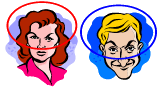


 Learn something about yourself with this
anonymous 1-question
Learn something about yourself with this
anonymous 1-question
